The working class men who risked everything at Jantar Mantar
They lost income and faced bruises. Blue-collar workers who travelled from other states explain why they camped at Jantar Mantar.

“We are already living in constant misery and dying a slow death. It's better to die here.”
When Arun, a 27-year-old cobbler from Uttar Pradesh, said this at Jantar Mantar on Friday, he had no way of knowing what would happen just a day later.
On Saturday, Union Education Minister Dharmendra Pradhan resigned, and the Cockroach Janta Party (CJP) called off its weeks-long agitation, declaring that the government had accepted all its demands. Protesters who had spent nights on the pavement started going home.
The movement’s public face, in the days that followed the July 20 police crackdown, was largely that of students, grieving and concerned parents, the CJP leadership, Sonam Wangchuk, young professionals and the influencers and content creators who turned Jantar Mantar into a live broadcast.
But standing shoulder to shoulder with them – sleeping on the same pavement, absorbing the same lathis – was another group that had gone comparatively unnoticed: plumbers, painters, masons, barbers, and cobblers, none of whom had any exam to sit for or any degree at stake.
They had the most to lose and the least to gain, but they showed up anyway.
This is their account of why.
‘Police were ruthless with us’
Speaking to Newslaundry, Arun showed his darkened bruises on his hand and leg from the police lathi charge on July 20.
“Even in a peaceful protest, they were so ruthless to us; I don’t know why,” he said. When asked if he is worried about detention, he added, “We are living in a country where I already feel like I am detained. We are unable to raise our voices or fight for our rights.”
He had been at Jantar Mantar for the past week. He was one of dozens of workers who travelled from across north India to join the CJP protests. Many of them travelled in groups ranging from 3 to 10 people. Some joined before July 20; others joined afterward, after seeing the police crackdown online. Several mentioned that word had spread mainly through Instagram.
‘Someone like me will die’
Mohammed Shahrukh Ansari, who works as a plumber, electrician, and construction labourer, and takes on loading and unloading work on the side, had been at the protest site since July 19. He was over 30 years old, well past the age of the students he had come to support, and he was careful to explain why that hadn't stopped him.
“I have come here as I have seen the problems and frustration of the youth. Tomorrow, it is very plausible I will face similar problems,” he said. “If tomorrow, because of the paper leak, someone illiterate becomes a doctor and messes up the system, then someone like me will die... Even my children’s future will be destroyed,” he said.
Shahrukh hadn’t told his family he was there. He had left home in Bahadurgarh, Haryana, and had slept at the protest site every night since. Sleeping at the protest site came with its issues. There was no designated space to take a shower, the washrooms were for public use and were not cleaned frequently, and there was an absence of basic supplies such as soap and trash bins. Yet, Shahrukh said he was there to stay.
What moved him most, he said, was what he saw on July 20, the day the police lathi-charged protesters. “Some people got head injuries. I saw someone get beaten on the stage; he fell while jumping over the barrier, and the police still kept hitting him with a lathi. This is wrong. This is authoritarian (tanashahi); that’s why I don't feel like going back home.”
He said he wasn’t afraid of what might come next.
The arithmetic of a lost wage
Showing up at Jantar Mantar was not free.
Shahrukh did the math out aloud: “Recently I earned Rs 500 and have already spent Rs 200. However, I am still left with Rs 200. Food is being provided at the protest site (Jantar Mantar) and I don’t have to buy my own food.”
Shiva, a 22-year-old labourer in Mumbai originally from Uttar Pradesh, travelled to Delhi for the first time in his life for the protest. He shrugged off the cost.
“I thought I could manage that later, but right now this is important for the country,” he said.
Jitendra, 22, lived in Azamgarh and cut hair for a living. He found out about the protest through Instagram reels and travelled to Delhi with his five other friends.
“I am losing money because I am here. What can I do? I have to come. If we don't come, then who will come?” His family, he claimed, told him to go.
Kishan, a mason from Gorakhpur who travelled in with four others, said the same, and added something more pointed. He had studied for a while before circumstances forced him to stop, which was partly why, he said, the future of other students mattered to him. “If, because of our presence, somebody’s future gets better, that’s enough for us.”
Detention, and the lack of fear of it
Almost none of the men interviewed treated the prospect of arrest as a deterrent. Vishal, a 25-year-old plumber and electrician from Narela, who had been coming back and forth since July 19, had already worked out what he thought would happen.
“I have heard that after detention they take you somewhere far and drop you off, so it won’t be a problem; I can come back again,” he said. He had told his family he was at the protest and was planning to stay a week, “but if my condition gets bad, then I’ll have to go back.”
Furqan Khan, not yet 20, had arrived from Aligarh the night before he was interviewed, against his mother's wishes. “That I have left in God’s hands. I am just going to be brave, even if there are 10 police officers or 20 police officers,” he said. He described himself as illiterate, and said he had come to speak up for his brother’s children. “I have nothing specific to tell the government; we are just raising our voices for our rights.”
Kishan, meanwhile, said he and the others hadn’t thought that far ahead, and that this was a fight for his friends who were then studying. “We have not thought of that. We just want our fight to be successful and for us to win. The education minister must resign, and a new education minister must come with people's support.”
‘Padhega India, tab hi toh badhega India’
Arun said, “I want the government to develop health and education in the country. The country will only be developed if the youths are educated. Only if India learns then India will grow (Padhega India, tab hi toh badhega India). The government must understand that even if they are not educated, they need to let those who want to be educated pursue it.”
He had kept his presence at the protest from them at first, worried about how his sister, who was still studying, would take it – and fearful that she could meet the same fate as those students who died by suicide following the NEET-UG paper leak this year.
“I am just scared that these kids killed themselves; the same incident doesn’t happen in my own home.”
Shahrukh was more direct about what he thought the state owed the youth of the country. “Our concerns are not being heard; it should happen soon. The concerns should have been addressed on the 20th itself because there was a large number of youths that day. The government should look at this and think that these are the youth of my country and that we need to do something for them. They used violence and tear gas, which was wrong. Youths need to get justice sooner because they haven't gotten any till now.”
A day later, Shahrukh’s demand was met. And when the announcement came, it belonged to the students as much as it did to all these workers.
(Dikshya Koirala is an editorial intern with Newslaundry.)
Small teams can do great things. All it takes is a subscription. Subscribe now and power Newslaundry’s work.
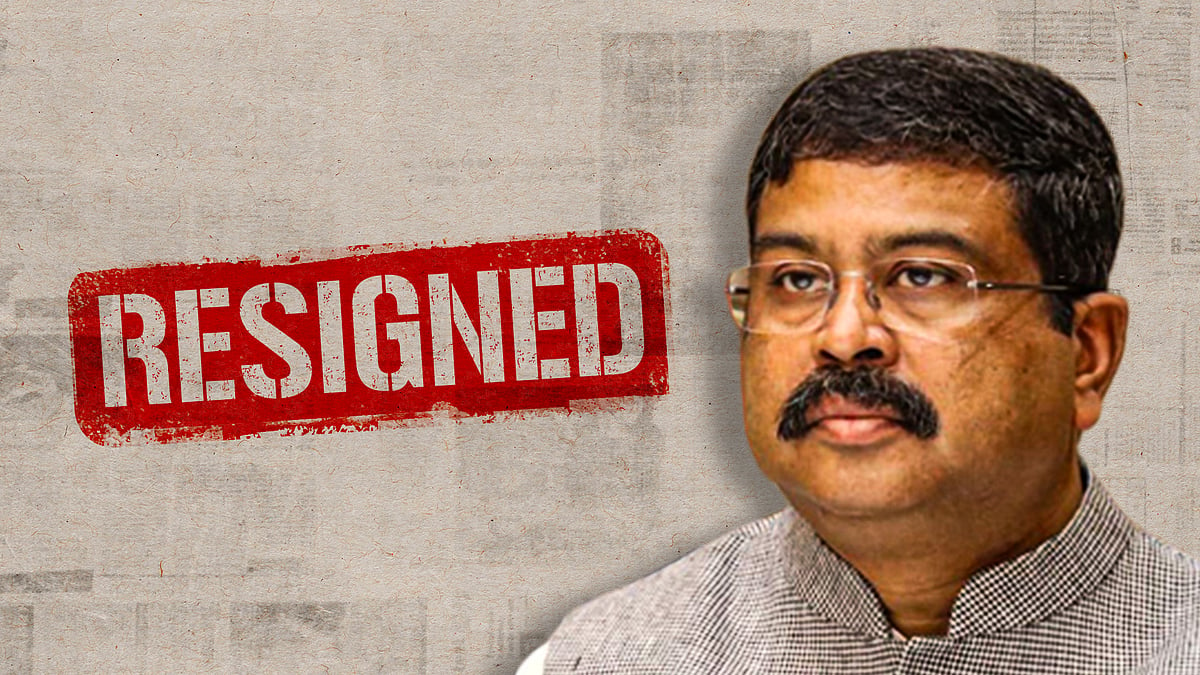 Dharmendra Pradhan resigns under pressure from student protests