As DU reopens, students decode ‘thinly veiled threats’ and Jantar Mantar protests
Amid library sign-ups, threat circulars, and minister resignations, incoming Delhi University students reflect on police crackdowns, paper leaks, and the growing cost of dissent.

There were fewer students than usual in Delhi University’s North Campus this week, as most of those who had joined days earlier were attending their orientation. You could find students across Hindu College, the Faculty of Law, Daulat Ram College, St Stephen's College and Hansraj College holding a piece of paper either registering for the library or completing their admission process, while actively following updates on the Cockroach Janta Party (CJP), which concluded its 36-day long protest on July 25.
The protest demanding accountability over a spate of examination paper leaks, including in NEET-UG, led to the resignation of Dharmendra Pradhan as education minister. He was replaced by Prahlad Joshi, who has since faced political backlash for his 2022 remarks defending the early release of 11 convicts in the Bilkis Bano gangrape case.
The protests also came against the backdrop of circulars from universities, including DU, JNU and Jamia Millia Islamia, discouraging students from participating in demonstrations at Jantar Mantar. DU’s circular, issued on July 23, warned that unlawful assemblies “may invite legal action” and urged students to “prioritise their safety and compliance with the law.”
A march to Parliament on July 20 saw police come down hard on protesters with lathis, tear gas and pellet guns. The Centre agreed to all three of the CJP’s core demands on July 25 including the withdrawal of FIRs against protesters, but CJP warned the movement would resume if the “harassment of students” by the police continued.
A walk through these college campuses showed student organisations had set up stalls. The Akhil Bharatiya Vidyarthi Parishad (ABVP), the student arm of the RSS, and the Collective, a left-leaning student organisation, had stalls displaying placards, books, and small cards – an apparent effort to draw students into joining their organisations.
In a separate protest, the National Students' Union of India (NSUI), the student wing of the Congress party, is holding an indefinite hunger strike outside the Faculty of Arts against the Vice Chancellor’s circular regarding the Jantar Mantar protest, with five participants taking part since 11 am on Wednesday, demanding an apology from the Vice Chancellor.
What everyday students are saying
A first-year English student from Hindu College, on her second day at the college, was holding an advertisement pamphlet and shared her thoughts on the CJP protest.
Speaking to Newslaundry on condition of anonymity, she said, “Protests are necessary. In this protest, people stood up for themselves. Whatever flagship programmes the government claimed to have run for students, they were not giving them.”
On the circular, she added, “It was a thinly veiled threat.”
A political science student from Prayagraj studying at Hindu College, who also spoke to Newslaundry on condition of anonymity, said, “Legitimate demands can force a resignation; at least they made the government answerable.” She did not join the protest because of her exams but has been closely observing what is happening.
“A system like DU tells students not to attend the protest, and in our class today, a faculty member said this generation is too intolerant and insecure. They are putting their ideology in the classroom. But when we tried to say something, they didn’t let us speak. From this, we can tell they are all part of the same system, just doing their job,” she added.
She further explained that this protest has at least made people aware of the “real issues”, and it has grown into a voice raised against injustice and intolerance. “If someone is held accountable through a resignation, that’s great. If this happens again, Gen Z will reunite. I think the police brutality happened because these officers are also fed up with the system and released their anger on the students,” she remarked.
Suman Mishra, a master’s student in history at Daulat Ram College, said that if students kept staying in activism and protesting to fix the system, their age would pass them by, leaving her to ask when they would actually get a job. Although she did not attend the protest herself due to her exams, she expressed support for it and remarked that she got all her information from her friend Shivanshu, who attended the march on July 20.
“I think in the protest, people acted as reporters – they gave live proof on Instagram, and that’s exactly what my whole algorithm showed me, which justified it as a peaceful protest. I also appeared for NET, and that paper was leaked too. Sonam Wangchuk participated, and his contribution to the protest was greater than CJP’s. It's a great thing that, for the first time, an education minister resigned from his position. CJP is still in its early stages, so they must be careful, or else it will create division,” she said.
Tesa, a first-year computer science student at St Stephen's who started college in the last few days along with four friends, said, “We haven’t heard good things about Prahlad Joshi. Everyone is under pressure from the government. Better education is the only demand or expectation students have. They should be held accountable for all of this.”
Chaitanya Sharma, a second-year law student who has not attended the protest, said the core issue was the paper leak, and that the protesters’ objectives were correct. She noted that students have died because of paper leaks, and spoke of the heavy financial burden of studying at coaching institutions. Her cousins, who were preparing for NEET, had their paper leaked too. She also asked, “Did anyone do a background check on Prahlad Joshi?”
Protesting against government’s retaliation
A new protest, organised by student groups including AISA, DSF, DSO, KYS, SFI and Collective among others, began at Jantar Mantar on Wednesday and ran into Thursday, concluding at 5.30 pm. It was a sign that the stir had resumed amid continuing harassment and repression of students who had participated in protests across different parts of India.
Sarthak of the Disha Students' Organisation (DSO) said, “It is clear that the government is trying every trick to retaliate against the students who came out to protest against the wave of paper leaks.” Students from left-leaning organisations, including DSO, AISA and SFI, have been arrested in Patna for participating in the protests, with an FIR also lodged against DSO’s national president. Naureen, an activist from DSO, said, “CJP should ask for a valid written assurance from the government, not a verbal one.”
On the circular issued by Delhi University, former Delhi University Teachers Association (DUTA) president and retired professor Nandita Narain said, “Universities have never issued circulars like this before,” while adding that she extended her support to this protest.
Pakiz Khan, a PhD scholar at JNU and president of the Democratic Students' Federation (DSF), along with Sunil, also a PhD student, said, “Because of the protest, new students are becoming sensitised and are gaining a critical lens more easily. These new students are now coming with questions about CJP and about what’s wrong with the education system.”
Neha Bora, activist and president of AISA, was on hunger strike alongside two other AISA students and Sonam Wangchuk, who was forcibly removed from the protest site by the Delhi Police on July 18, two days before the scheduled march to Parliament. The AISA students broke their fast when Pradhan resigned, while Wangchuk broke his fast in hospital.
Speaking at the Wednesday protest, days after ending her fast, Neha said, “Andolan tabhi mukalam samjhenge jab sab riha honge, tab tak movement adhura ha.” (We’ll only consider the movement successful once everyone is released; until then, it remains incomplete.) She added that a march is planned in Kolkata for protesters still detained by the police.
Small teams can do great things. All it takes is a subscription. Subscribe now and power Newslaundry’s work.
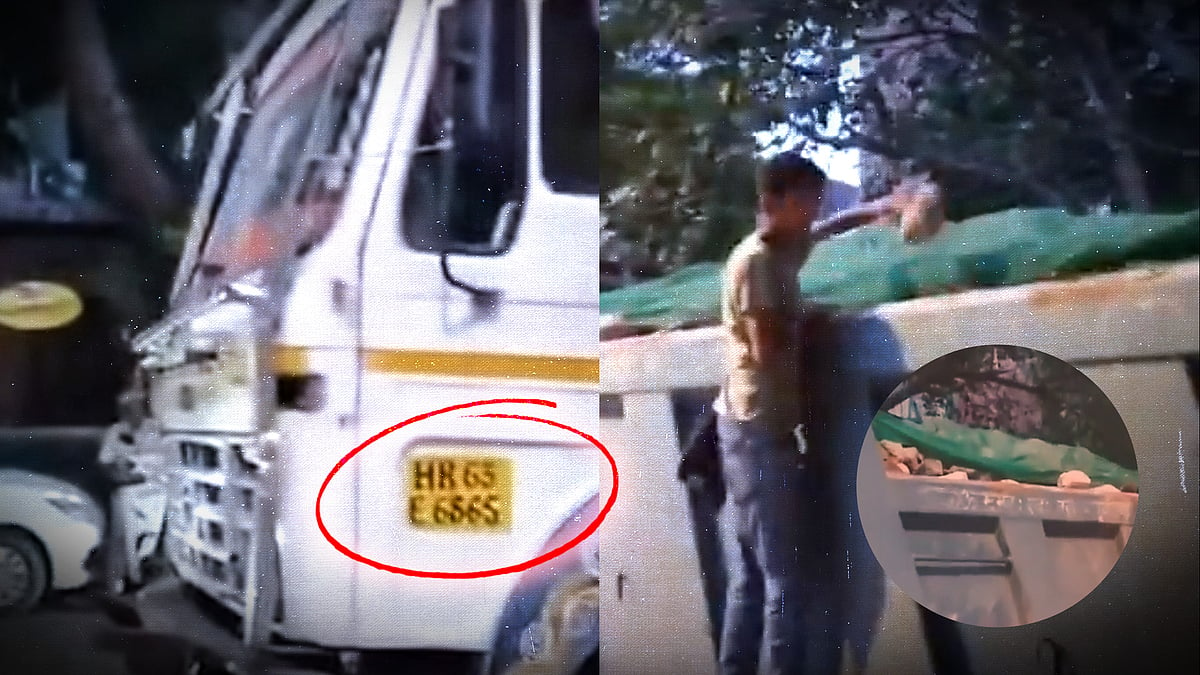 A truck full of stones appeared near the CJP protest. We found out how
 From India Against Corruption to CJP: Abhinandan returns to Jantar Mantar