After Uttarakhand, it’s MP: CM Yadav spent Rs 230 cr to sell a Rs 30 lakh cr ‘MoU’ mirage
Amit Shah and CM Mohan Yadav hailed Madhya Pradesh’s Rs 30.77 lakh crore in ‘MoUs’ at the Bhopal Global Investors Summit. The government later changed the word to ‘intent proposals’. The agency in-charge of the glitzy investment summits now says it was all presented as received without verification.

On February 25, 2025, Union Home Minister Amit Shah closed Madhya Pradesh’s Global Investors Summit in Bhopal by announcing that MoUs worth Rs 30.77 lakh crore had been signed at the two-day event, more than seven times the state’s budget for 2025-26.
He had full faith, he said, that most of them would bear fruit.
Speaking from the same stage, Chief Minister Mohan Yadav widened the claim. “We have signed MoUs worth Rs 30.77 lakh crore during the two-day Global Investors Summit and some Regional Industrial Conclaves,” he said, referring to seven smaller investor meets held in the months before.
By February 2026, the government was telling the assembly there had been no MoUs for industry at all.
Answering Congress MLA Vikrant Bhuria, Yadav’s reply said “not a single MoU had been signed” at the summits between 2020 and February 2026 for setting up industries. What the state had, it said, were “investment intent proposals” filed online with the Madhya Pradesh Industrial Development Corporation (MPIDC), the state agency that runs the summits.
And now, the MPIDC seems to have given the number yet another description.
The Rs 30.77 lakh crore, its managing director, Chandramouli Shukla, told Newslaundry in response to questions, is the “total of intentions to invest, proposals received by departments and agreements signed with public agencies, announced as received” between the 2023 summit, held under the previous chief minister, Shivraj Singh Chouhan, and the 2025 one under Yadav.
Shukla said it adds up intents filed online, at the seven regional events, at interactive sessions, foreign roadshows, proposals received by state departments during the summit, and agreements signed between government bodies and government-owned companies. “In public communication it was referred to by the general term MoUs,” he wrote.
Bigger than this terminological sleight of hand is the entities that made it to the list.
Newslaundry accessed and examined the list of investment proposals that were mentioned in Yadav’s February reply. Its biggest entry, worth Rs 3 lakh crore, is from a company set up less than eight months before the summit, which ended its first year with Rs 10,556 in cash and bank balances.
The remaining four of the five biggest entries are government departments or government-owned companies.
Further down are a momo stall that shut two years ago but is listed with a Rs 50 crore proposal, a hair salon credited with a Rs 3,000 crore proposal, entries named “October”, “chikni aatma” and “not applicable”, and one in the chief minister’s own name, though there is no suggestion he filed it.
MPIDC’s Shukla said, “Investment promotion agencies follow one of two conventions. Some announce the total received at the event and verify it afterwards; others announce only verified commitments, usually once a year. The state follows the first…the figure was never presented as investment on the ground.”
In a separate assembly response, the government even named industries it says came up through the summits. When Newslaundry checked a sample across six districts, it found decades-old shops, factories built years before the summits and units that had already shut, all recorded as industries set up between 2023 and 2025. Several owners did not even know they had been counted.
On such entities and those with bizarre names described above, Shukla said the “MPIDC’s examination has found compilation errors of the kinds” and “reconciliation” is “being carried out”.
The system in Madhya Pradesh appears to follow what we reported previously from BJP-governed Uttarakhand, where the Pushkar Singh Dhami government seems to have used unwitting local businesses, ghost projects, and the state’s own ventures to pad its Rs 1-lakh-crore grounded investment claims. Watch that report here.
All this has cost public money.
Assembly documents show the government spent about Rs 230 crore courting investors between March 2024 and November 2025 alone under Yadav: Rs 186.64 crore on 10 summits and investor meets, about Rs 34 crore on three foreign trips by the chief minister, and Rs 9.05 crore on investor meetings in nine Indian cities. The two-day Bhopal summit alone cost around Rs 82 crore, Yadav told the House in his March 2025 reply.
Intents are not legal commitments, and this is not an audit of every entry. But the records suggest that headline investment figures were added up and announced long before anyone meaningfully vetted the credibility, finances or execution capacity of the entities behind them.
While MPIDC says the records placed before the assembly are being checked and corrected, CM Mohan Yadav did not respond to questions; this report will be updated if he does.
The Rs 3 lakh crore ‘investor’
The biggest proposal on the list of investment intents is not from Reliance, Adani or any of the global CEOs paraded at the summit.
It is from a company listed as Kaymali Ventures Pvt Ltd, credited with a Rs 3 lakh crore potential investment. That alone is nearly a tenth of the Rs 30.77 lakh crore. It is almost three times the Rs 1.1 lakh crore the Adani Group announced was under discussion from the summit stage, and more than two-thirds of the state’s entire 2025-26 budget of Rs 4.21 lakh crore.
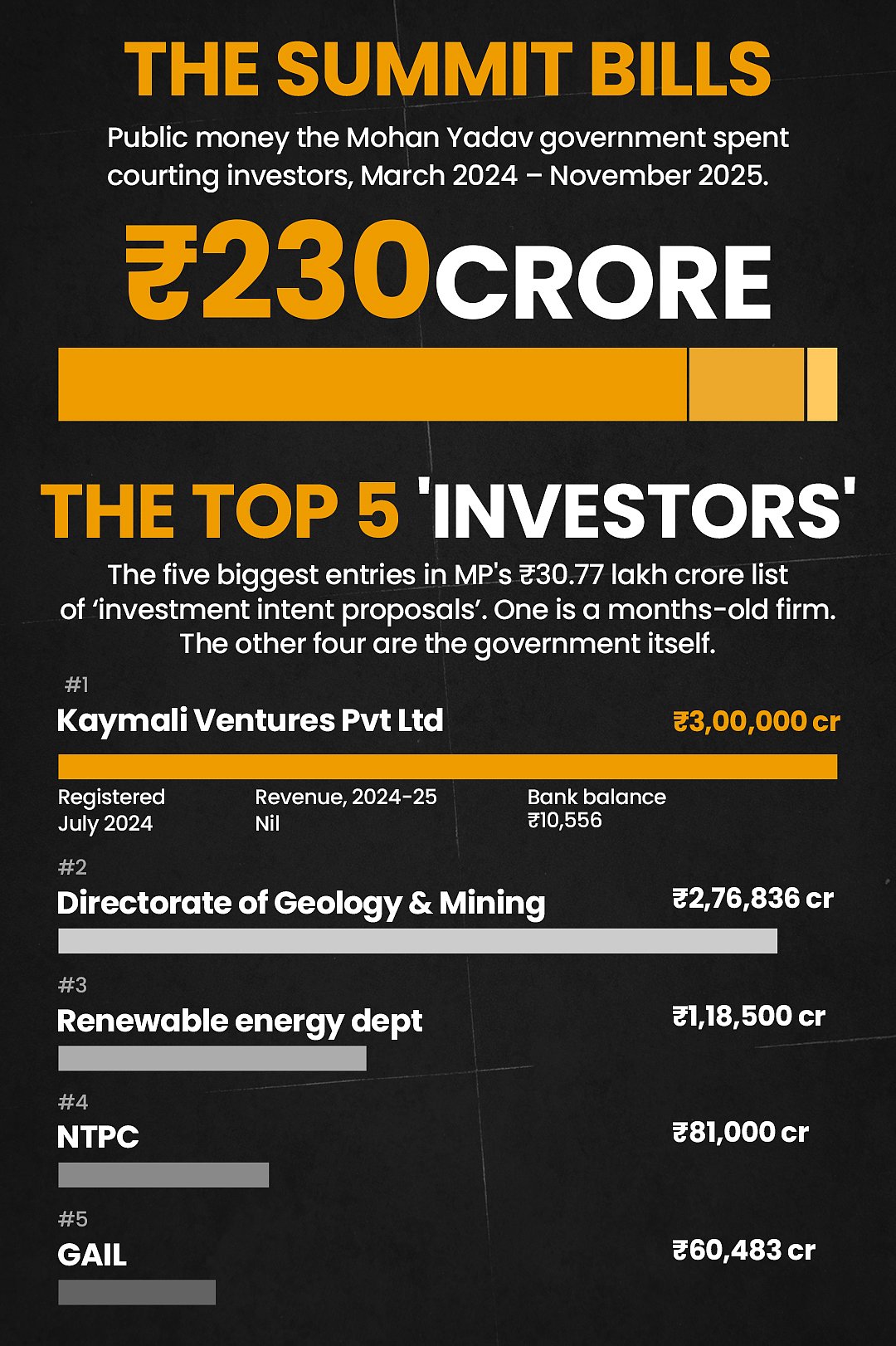
Corporate records list it as Kaymli Ventures Private Limited, registered in Jodhpur, Rajasthan, on July 4, 2024. Its directors are Shiv Narayan Singh and Vikram Singh, and its registered business is managing investment funds. Its website describes a venture capital firm and names Shiv N Singh as CEO and Maeed A Alshehri, who it describes as a retired major general of the Saudi National Guard and general partner.
But the company’s accounts for 2024-25, reviewed by Newslaundry, show no revenue.
It borrowed Rs 5,91,149 and spent Rs 5,78,700, including Rs 2,06,677 on travel. It ended the year with a loss of the same amount, Rs 10,556 in cash and bank balances, and paid-up capital of Rs 10,000.
Put another way, the proposal is about 50 lakh times what the company borrowed that year and 28 crore times the cash it held. Even its website’s claim of $122 million in “financial acumen”, taken at face value, comes to roughly Rs 1,000 crore, a third of one percent of the proposed sum. The same site, whose terms of use date from July 2024, boasts about the companies it has seed-funded over the past decade.
Filing an intent costs nothing. A venture fund can in principle raise money from others, and Newslaundry does not know what Kaymli proposed or who might back it. But nothing in the record shows that anyone asked whether the company could raise even a sliver of Rs 3 lakh crore before the figure went into a total read out by a Union home minister.
Newslaundry has sought comment from Kaymli Ventures and Shiv Narayan Singh. This report will be updated if they respond.
The government, investing in itself
The next four names on the proposed investments list are not investors in any ordinary sense. They are two state government departments and two central government-owned companies, together worth about Rs 5.37 lakh crore, or about 17 percent of the total. With Kaymli, the top five make up nearly 26 percent.
Leading them is the state’s Directorate of Geology and Mining, at Rs 2,76,836.33 crore. The directorate regulates mining and auctions mineral blocks, and MPIDC confirmed that departmental totals included “mineral blocks under the mining department”. The list does not say whether the figure is the value of the minerals or investment expected from future bidders. Either way, it appears to be the state listing what it has to sell, not what would traditionally count as an investor promising to spend.
Next, at about Rs 1,18,500 crore, comes “Naveen Evam Naveekarniya Urja”, the name of the state’s renewable energy department. That is close to the Rs 1.2 lakh crore MoU NTPC Green Energy signed at the summit with the renewable energy department’s MP Power Generating Company, for a joint venture meant to help state utilities meet their green-power obligations. Though NTPC itself is listed in the list at Rs 81,000 crore, probably for its second MoU with the state for non-fossil power plants. Newslaundry could not confirm that the list entries are for these same MoUs.
If they do, they show how the assembly reply can be technically correct and publicly misleading at once. MoUs were signed at the summit, in the chief minister’s presence. But they were between public bodies, so none counts as an MoU “for setting up industries”.
GAIL, the central gas utility, is fifth at Rs 60,483 crore. In June 2024, eight months before the summit, GAIL had announced a roughly Rs 60,000 crore petrochemical complex in the state. If that is the project on the list, the summit is being credited with an investment announced well before it.
Further down are the development authorities of Indore (over Rs 10,000 crore), Bhopal (Rs 6,500 crore), Gwalior, Ujjain and Jabalpur, a central government employees’ housing body, a state electronics corporation and the Union renewable energy ministry.
Public projects can be real, and some of these will get built. But government companies plan spending through their boards, and state agencies spend public money; neither needs a summit. A summit is actually meant to attract private capital, former Union finance secretary Subhash Chandra Garg told Newslaundry for this series’ Uttarakhand report.
‘October’, ‘Chikni Aatma’ and the chief minister
Some entries do not look like investors of any kind.
“Chikni Aatma” is credited with Rs 5 crore, “Computer” with Rs 100 crore, “Vyavsayi” with Rs 15 crore, “Showroom” with Rs 5 crore and “Darwaze Par Vasiyat” with Rs 1 crore, among others. “Farmer”, “Not Applicable”, “Bahno ka Sangrah”, “October” and “Kisan Morcha” are each listed at exactly Rs 200 crore. They are all associated with Bhopal’s global summit.
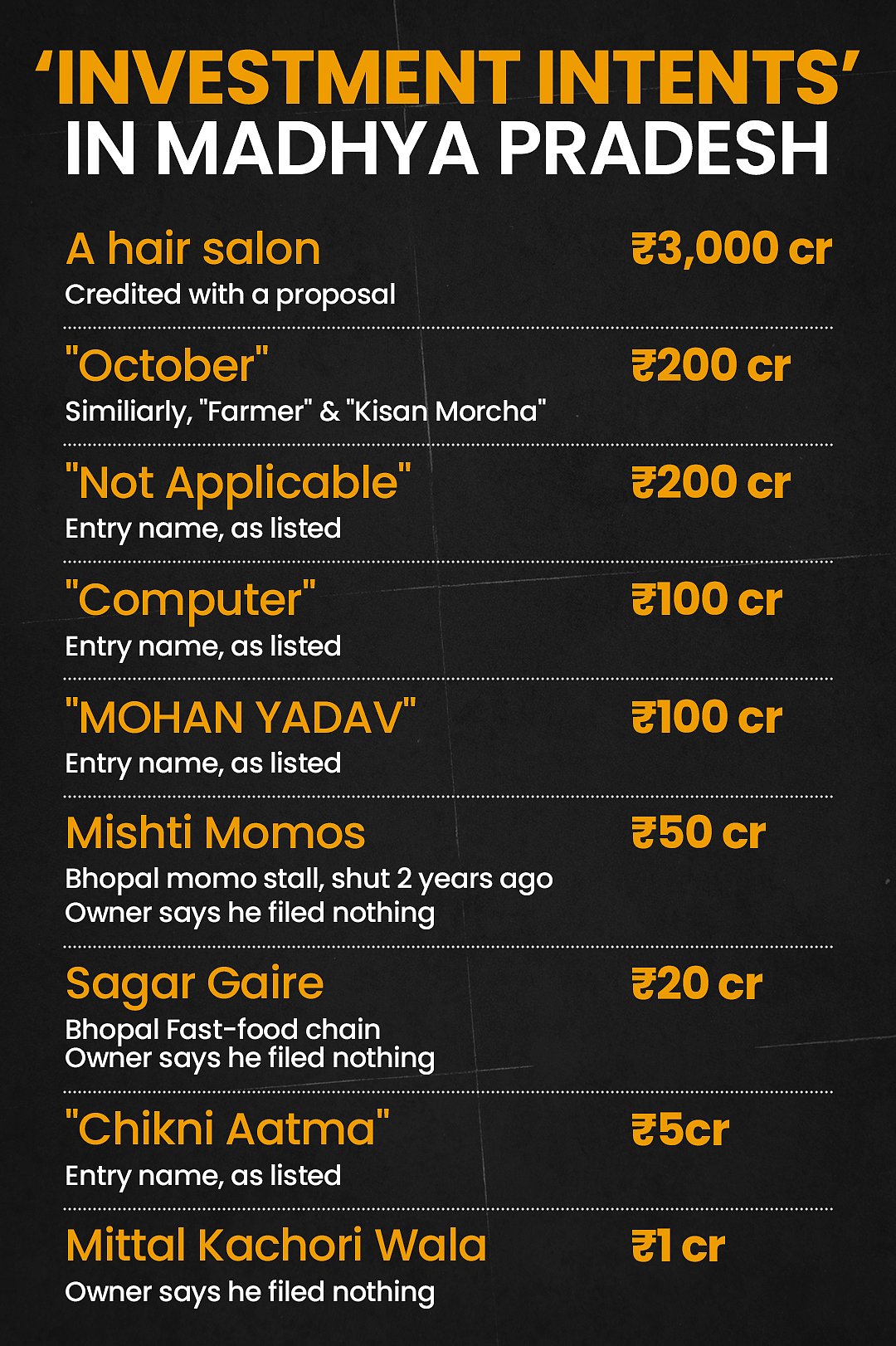
And there seems to be one “CM Mohan Yadav”, credited with Rs 100 crore. Shukla said it was one of several entries made by people registering for passes to attend the summit, who “entered a name and a figure in free-text fields”, boxes in which anyone could type anything.
That explanation raises more questions than it answers. Why would a form for summit passes ask for an investment figure? How did what people typed into it end up in a list of investment proposals placed before the legislature, and were those entries counted in the Rs 30.77 lakh crore? It does clearly suggest a process that had no visible check between a name typed into a form and a record placed before the assembly.
There is a list of investment proposals and a list of industries that came up with help from the government's efforts. Of the top five investment proposals, the biggest is by a startup with around Rs 10,000 in cash and bank deposits, and the rest four by the government's own companies. The list of industries too is replete with its own strange patterns, from shut units counted as new to plot holders counted as investors.
Momos and kachoris
The Bhopal global list also includes liquor contractors, namkeen and sweet shops, goat and poultry farms, garment stores, salons, kirana stores, dairies, cycle shops, pathology labs, cinema halls and stone crushers, many credited with proposals worth crores. Bharat Talkies, Kushwaha Kirana Store, Saadhna Bakri Farm, Parag Mithai, Star Gents Parlour and Jawahar Tent House are among them.
Small businesses can be genuine investors, but several Newslaundry contacted said they had filed nothing.
Mayank Saxena shut Mishti Momos, his rented food outlet in Bhopal, about two years ago, after it kept losing money. The list credits Mishti Momos with a Rs 50 crore investment proposal. “I have not made any investment proposal at any business summit,” Saxena said. “It’s entirely wrong that they have shown an investment proposal of Rs 50 crore in my name.”
Sagar Gaire, a popular Bhopal fast-food chain, is credited with Rs 20 crore. Its owner, also named Sagar Gaire, said he had never filed a proposal, attended a summit or submitted any form to MPIDC. In Indore, Prajay Mittal of Mittal Kachori Wala, listed at Rs 1 crore, said he had proposed nothing of the kind and had not even gone to Bhopal for the summit.
Some other strange patterns in another reply
In another reply in the assembly in December 2025 to a question raised by BJP MLA Chintamani Malviya, Chief Minister Yadav listed 746 industries that had been established on the ground over the past two years. Outside the House, Yadav said in July that projects worth more than Rs 10 lakh crore are already on the ground.
So Newslaundry checked a sample of entities listed by the government across Gwalior, Bhopal, Raisen, Indore, Mandsaur and Shajapur, asking of each unit whether it was new, whether the investment was new, and whether either owed anything to the summits. Three patterns recurred.
The first: old businesses recorded as new.
For example, Dev Garments in Gwalior is listed as set up about two years ago, with Rs 90 lakh invested and 30 jobs. The Dev Garments we traced is a small shop in the old Lashkar area that has sold kurtas and pyjamas from the same spot for eight years. Its owner, Rahul Bansal, said he had invested nothing and attended no summit. The only MPIDC form he recalled was an application for a plot in a readymade garment park eight years ago, which he withdrew.
Lakhan Bamoria, a wholesale clothing trader for 16 years, bought a plot in MPIDC’s readymade garment park in January 2020, built a small unit and moved his business there from his Birla Nagar home in 2022. The list shows his Yatharth Garments as set up between 2023 and 2025, with Rs 85 lakh and 23 jobs; he says seven or eight people work there. “If they are showing that I am an investor who established a factory in 2023, 2024 or 2025, then they are simply manipulating the facts,” he said. He said he did attend the regional conclave the chief minister chaired in Gwalior in August 2024, two years after his unit opened, and said MPIDC officials later had him fill in a form with his land cost, building cost and staff numbers. “Maybe they used that information to show me as an investor.”
In Bhopal, Mohammad Saeed has made maxi dresses under the name Anam Boutique for 30 years, from a small unit in his lane in Shahjahanabad. He leased land in the Acharpura industrial area in 2022, but the factory is still unfinished. The list shows Anam Boutique as set up in Acharpura in 2025 with Rs 75 lakh. Saeed and his son went to the Bhopal summit too, as visitors, handing over their GST number to get passes. “There is a big difference between being a visitor and being an investor,” said the son, Mohammad Saad.
Nearby, Habiba Foods, which makes bakery ingredients, is listed as started in 2024. Its owner, Shadab Khan, said he began at home in 2009, got his Acharpura plot in 2018 and was running operations by late 2022, on his own money and a Rs 32 lakh bank loan. He has attended no summit.
In Mandsaur, Divyanand Herbals is shown with Rs 2.8 crore and a land allotment in 2024; its manager, Rajendra Arya, said the factory has run since 2021, when then chief minister Shivraj Singh Chouhan inaugurated it. If the 2024 allotment was for an expansion, the record does not say so.
The second pattern: units that had shut, counted as set up.
Kanha Flour Mill in Bhopal’s Bagroda industrial area is listed as a new Rs 45 lakh investment of 2024. Newslaundry found its shutters down and, inside, a dark hall of idle machines. Its owner, Naveen Kumar, said he set it up in 2017 with a loan under the Prime Minister’s Employment Generation Programme, started operating in 2018, and closed three or four years ago after losing Rs 60-70 lakh.
Patel Foods, a namkeen unit nearby, is listed as set up in 2025 with Rs 99.65 lakh. At its address hangs another company’s board. Its owner, Rakesh Patel, an ex-serviceman, said the factory opened in 2018 and he shut it in 2024 after losses. “Now I am living on my pension and trying to repay the loan I took to set up the business,” he said. “How can they show me as an investor when my business has already shut down due to losses?”
Some entries do not look like investors of any kind. “Chikni Aatma” is credited with Rs 5 crore, “Computer” with Rs 100 crore, “Vyavsayi” with Rs 15 crore, “Showroom” with Rs 5 crore and “Darwaze Par Vasiyat” with Rs 1 crore, among others. “Farmer”, “Not Applicable”, “Bahno ka Sangrah”, “October” and “Kisan Morcha” are each listed at exactly Rs 200 crore. They are all associated with Bhopal’s global summit.
Shree Maa Agro, a grain mill listed as set up in 2025 with Rs 1 crore, opened in 2021 and has since closed: in 2025, according to its owner, Prem Lal Chandani, or about two years ago, according to neighbours. India Book Depot, a 50-year-old Bhopal stationery shop, appears as a food-processing unit set up in Bagroda in 2023. One of its owners said the family ran a unit there from around 2021 and sold it around 2023 to a sweets maker.
In Gwalior, the Ashram Road address of Bhagwati Garments, listed with Rs 80 lakh and 23 jobs, is now a shop called Kavya Cosmetics. Arun Rajawat, who runs the shop next door, said Bhagwati Garments, a clothing business run by one Rahul Soni, closed about eight years ago. We could not reach Soni.
The third pattern: plot holders counted as investors. Arvind Jain’s Navratna Milk Dairy in Shajapur’s Maksi is listed as a Rs 1.5 crore investment of 2025. Jain said he bought an industrial plot about two years ago and has attended no summit. In October 2025, he said, an MPIDC official called to ask whether the chief minister could inaugurate the plot online and whether he planned to build. He said yes to both and heard nothing more. “I was not even aware that I have been listed as an investor.”
In Mandideep, Ramjeevan Gurjar borrowed Rs 3.5 crore in 2025 to buy a closed mill opposite his fabrication unit. Losses have kept it idle. The list shows it as a Rs 1.3 crore investment that created 12 jobs.And in Mandsaur, Dosi Masale is listed as started in 2024 with Rs 65 lakh, though its owner, Palash Dosi, said he started the plant only in January 2026, after finishing his MBA, and has never attended a summit.
MPIDC says the industries are recorded by date of land allotment and start of work, not of production. That may explain a plot allotted in 2024. It cannot explain a factory built in 2022 on land bought in 2020, a mill shut for years, or a snack unit recorded as set up a year after it closed. Nor does it touch the larger claim: that these industries came up on the back of the summits. By their owners’ accounts, most of the units Newslaundry checked had nothing to do with them.
What MPIDC says
Shukla’s detailed reply to Newslaundry noted that of the Rs 30.77 lakh crore, Rs 26.61 lakh crore was announced at the Bhopal summit and Rs 4.16 lakh crore came from events before it. The government agreements in the total include a National Highways Authority of India deal for about 4,010 km of roads and the NTPC Green Energy MoU.
Read the full reply and the attached annexure here.
The state, Shukla said, has not signed MoUs with private investors at its summits since 2014; since 2016, private interest has been logged as an “intention to invest” on the Invest MP portal. “The assembly reply concerns MoUs signed with private industrial investors, of which there were none,” he wrote.
An MoU, which is not legally binding, needed someone to sign across a table. A portal entry needs a name and a number, and becomes a lead for officials to chase. Shukla’s reply indicates the same. “The register placed before the House was the record of intents as received. It was not verified entry by entry before it was furnished, because verification takes place at the follow-up stage…The departments concerned are following up with the investors…the list will be re-submitted.”
Assembly documents show the government spent about Rs 230 crore courting investors between March 2024 and November 2025 alone under Yadav: Rs 186.64 crore on 10 summits and investor meets, about Rs 34 crore on three foreign trips by the chief minister, and Rs 9.05 crore on investor meetings in nine Indian cities. The two-day Bhopal summit alone cost around Rs 82 crore, Yadav told the House in his March 2025 reply.
Rs 34 lakh crore and counting
None of this has slowed the official announcements.
On a trip to Dubai in September, the government claimed proposals worth over Rs 53,000 crore, two-thirds of it from a single group. Yadav now puts the state’s tally at more than Rs 34 lakh crore, with over 30 percent on the ground. A Mumbai roadshow on October 8 added a claimed Rs 90,000 crore. The next global summit is in Bhopal in January 2027.
Madhya Pradesh does attract real factories, such as the Rs 272 crore LiuGong plant Yadav opened at Pithampur in July.
But the question is whether the number read out at the next summit will mean anything until the government publishes a new vetted list.
This report is part of a series examining investment claims at public-funded events.